

Check if you overpaid stamp duty — and claim it back
Most homebuyers overpay on items that are legally exempt. Run a free check in 30 seconds, then file the claim yourself and keep every penny of it.
Refund estimator
Free. No email required.
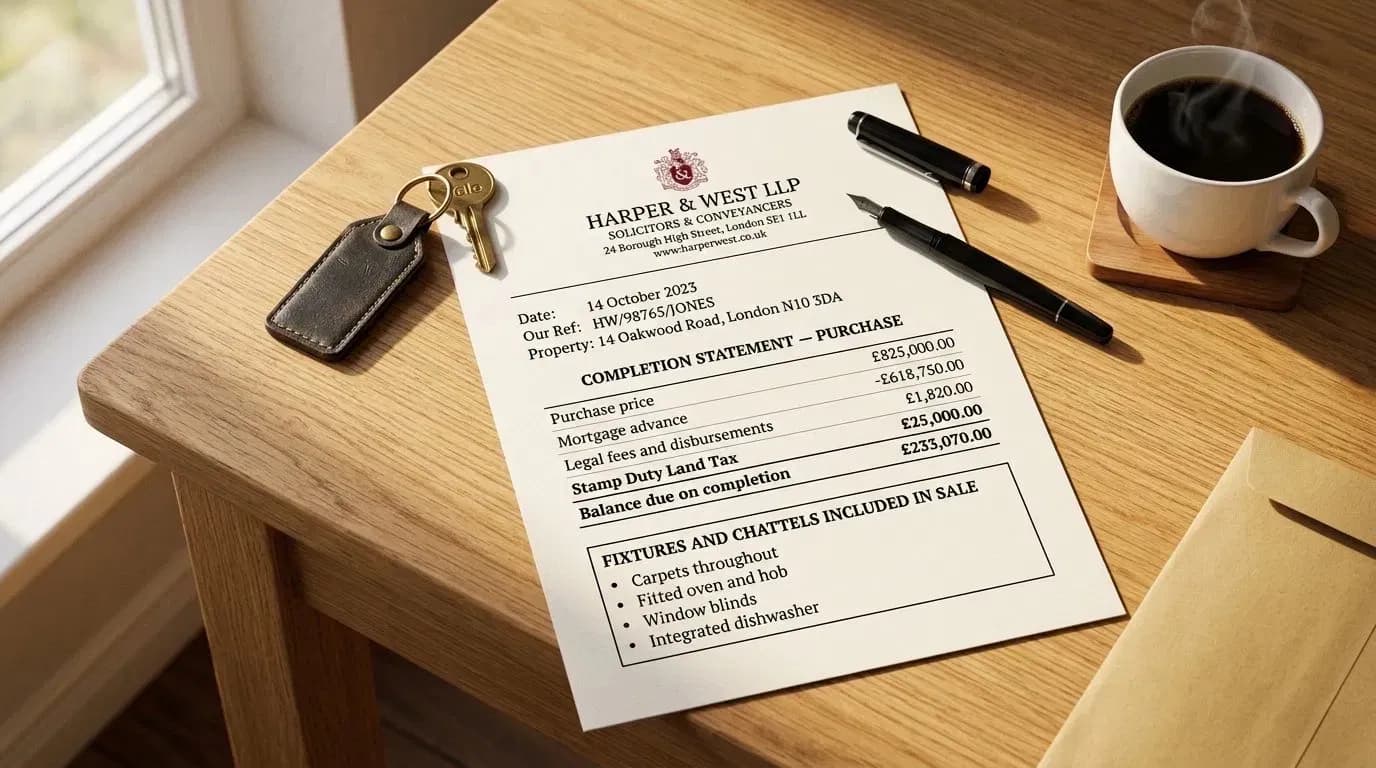
A completion statement, marked up
Independent. Not a claims firm. We just show you the facts.
Did you pay the additional-property surcharge — and later sell your previous home?
If you bought a second home, then sold your previous main residence within 3 years, you can reclaim the entire HRAD surcharge from HMRC — provided you claim within 12 months of the sale (or 12 months from your SDLT filing date, whichever is later). For an average UK home, this is typically £6,000–£20,000. Most buyers never claim it.
Check if you're owed the surcharge refund →We check four overpayment categories
Most overpaid SDLT falls into one of four categories defined by HMRC's own guidance. Our 6-question refund check screens your purchase against all four in 90 seconds — each one has its own rules, and its own evidence test.
Chattels overpayment
Moveable items included in your purchase — carpets, curtains, freestanding white goods, furniture — should not form part of the SDLT-taxable amount. Most buyers pay tax on the full price by default. HMRC's guidance (SDLTM04010) confirms the exclusion.
Typical refund: £400 – £1,500
Learn more →Second home surcharge refund
If you paid the additional-property surcharge on a second home and later sold your previous main residence within 3 years, the entire surcharge is reclaimable. The single biggest SDLT refund category — and the most commonly missed.
Typical refund: £6,000 – £20,000+
How to claim the second-home surcharge back →Non-residential reclassification
Properties with commercial elements (annexes, land, businesses) or that were uninhabitable at completion may have been wrongly taxed at residential rates. The non-residential rate is materially lower — and the reclassification window stays open for four years.
Typical refund: thousands to tens of thousands
Learn more →Multiple Dwellings Relief
If you bought a property with more than one self-contained dwelling (granny annexe, separate flat, multiple units), MDR could substantially reduce the SDLT due. Available for completions before 1 June 2024 — the window remains open for four years from that completion date.
Typical refund: thousands
Learn more →Each category is screened by our 6-question refund check using HMRC's own classification rules. No commitment, no upfront fee — only a recommendation on the best route forward for your specific purchase.
See which of these four routes apply to your purchase in 90 seconds — no email needed.
Check which routes apply →The DIY Claim Pack
File your claim yourself — keep 100% of your refund
An overpayment relief claim is a written claim to HMRC. You are entitled to make it yourself — no representation required. The pack is everything you need to do that properly, in the order HMRC expects it.
What's inside
- Decision treeWhich claim route applies to you — online amendment vs letter
- How to find your UTRNThe reference HMRC needs to process your claim
- Chattel valuation guideDefensible second-hand values for 40+ common items
- Chattel schedule templateThe formatted document HMRC expects
- Pre-drafted letter templateEvery required element included, ready to personalise
- What to expect from HMRCTimeline, risks, and the 9-month investigation window
- What to do if HMRC queries your claimResponse guide and appeal process
£19.99 once— a claims firm handling the same £6,000 surcharge refund would keep £1,500–£2,400 of it.
Get the DIY Claim Pack — £19.99You can file this claim for nothing using our free step-by-step guide. The pack adds the parts that take the longest to get right: ready-made HMRC letter templates, the chattel schedule in the format HMRC expects, defensible valuations for 40+ common items, and wording checked against the elements a claim has to contain. It saves hours of drafting and removes the most common reasons a claim gets queried.
Based on HMRC's own guidance
One price, any refund size
Yours to keep, file at your own pace
Where are you starting from?
We'll show you the right tools in the right order.
What is a stamp duty chattel refund?
When you buy a property in England or Northern Ireland, Stamp Duty Land Tax (SDLT) is charged on the purchase price. But HMRC's own guidance — SDLTM04010 — confirms that moveable items included in the sale are not subject to SDLT. Carpets, curtains, freestanding white goods, furniture, garden sheds: none of these should form part of the taxable consideration.
Most buyers pay stamp duty on the full purchase price without deducting chattels — either because their solicitor didn't advise them to, or because nobody thought to apportion the value at the time. The result is a systematic overpayment that HMRC allows you to correct through an overpayment relief claim, up to four years after completion.
How much stamp duty could you get back?
The refund depends on two things: the total second-hand value of chattels included in your purchase, and which SDLT band your property falls in. A typical furnished property might include £8,000–£15,000 of chattels. On a £400,000 purchase — where the marginal SDLT rate is 5% — that translates to a refund of £400–£750. On a £700,000 purchase at 10%, the same chattels could produce £800–£1,500 back.
Use our free refund estimator to walk through your property room by room and get a personalised estimate in under two minutes.
Who can make a stamp duty chattel claim?
You can claim if you bought a residential property in England or Northern Ireland within the last four years, and the property came with moveable items that weren't separately valued and deducted from the purchase price. You don't need a specialist to claim — HMRC allows buyers to submit overpayment relief claims themselves, either online (within 12 months of filing) or by post (up to four years after completion).
You can file this claim yourself. Our DIY Claim Pack gives you the letter template, chattel schedule, and valuation guidance for £19.99 — the same price whatever your refund is worth, and you keep all of it. No-win-no-fee claims firms will do it for you instead, but they typically keep 25–40% of the refund.
What counts as a chattel for stamp duty purposes?
HMRC defines chattels as tangible, moveable items — things that are not permanently fixed to the building or land. Common examples include fitted carpets (but not glued-down carpets), curtains and curtain poles, freestanding white goods (washing machine, fridge freezer, dishwasher), freestanding furniture, loose rugs, garden furniture, and removable garden sheds.
Fixtures — items permanently attached to the property — cannot be deducted. These include fitted kitchens, integrated appliances, bathroom suites, built-in wardrobes, and wired light fittings. The distinction is not always obvious. Use our AI Chattel Checker to get an instant ruling on any specific item based on HMRC guidance.
Frequently asked questions
Yes — HMRC guidance explicitly excludes chattels (moveable items) from Stamp Duty Land Tax. You're entitled to pay SDLT only on the land and buildings, not on moveable contents like carpets, curtains, and appliances.
It depends on your property value and what was included in the purchase. Typical refunds range from £500 to £10,000+. Use our refund estimator for a personalised estimate.
HMRC typically processes SDLT refund claims within 15–20 working days, though complex cases can take longer.
Yes. You can claim overpayment relief within 4 years of your purchase date. After that, the window closes permanently. For return amendments, the deadline is 12 months and 14 days from the filing date.
No. HMRC lets you submit the claim yourself, online or by post, and our £19.99 DIY Claim Pack contains the letter template, chattel schedule and valuation guidance to do it. No-win-no-fee claims firms will handle it for you instead, but they typically keep 25–40% of the refund.
Chattels are moveable items not permanently fixed to the property. Common examples include fitted carpets, curtains, freestanding white goods (fridge, washing machine), furniture, garden sheds, and light fittings.